

(CURRENT) BSIE curriculum effective August 2026
Undergraduate Studies: BS Industrial Engineering (effective August 2026)
IE Undergrad Program Handbook (Updated as of June 27, 2026)
OBJECTIVE
The objective of the Bachelor of Science in Industrial Engineering program is to provide a sound foundation in science and engineering in preparation for a professional Industrial Engineering career. The main tracks of the program are Production Systems, Operations Research, Human Factors and Ergonomics, and Information Systems.
FRESHMEN ENROLLMENT QUOTA
One hundred and ten (110) students.
DURATION
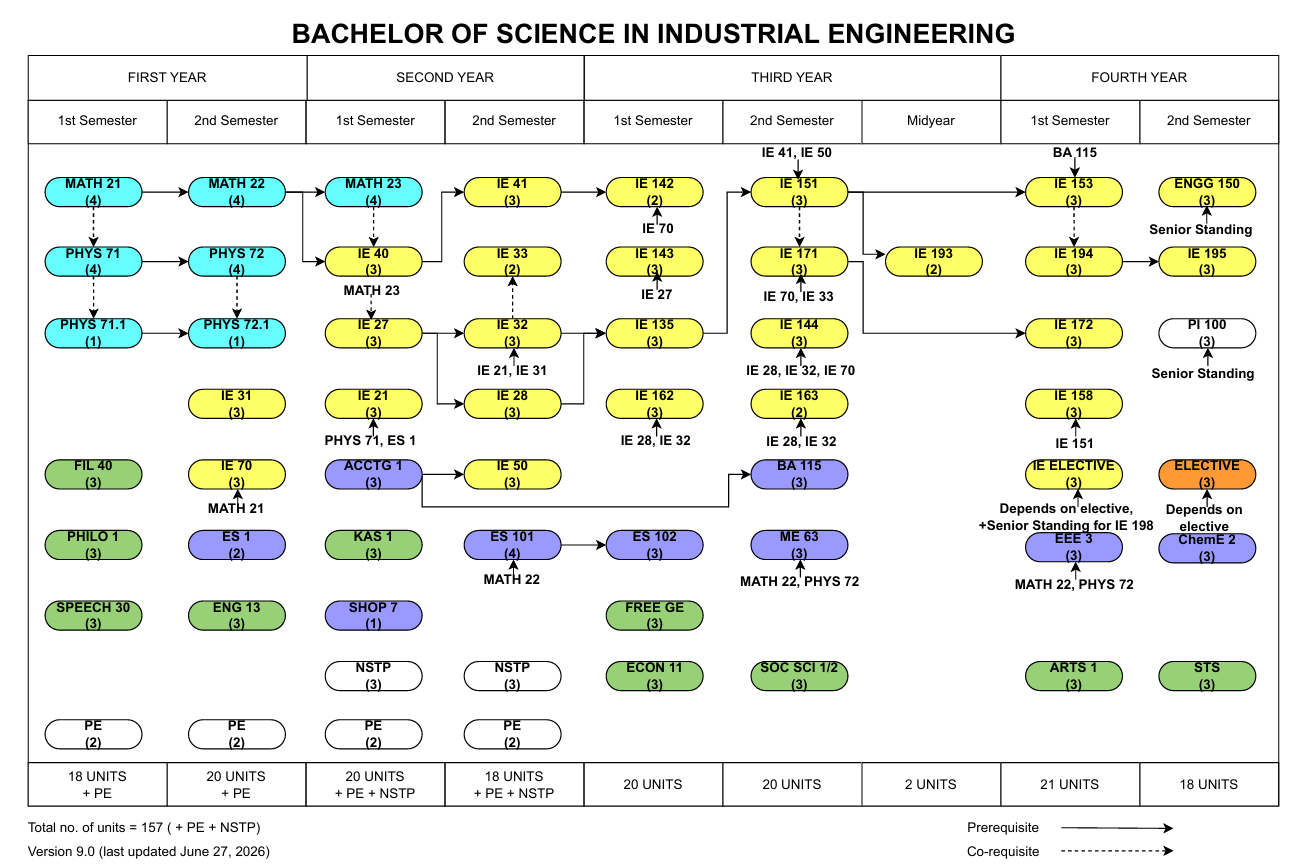
STEM STRAND: 4 years, 157 units
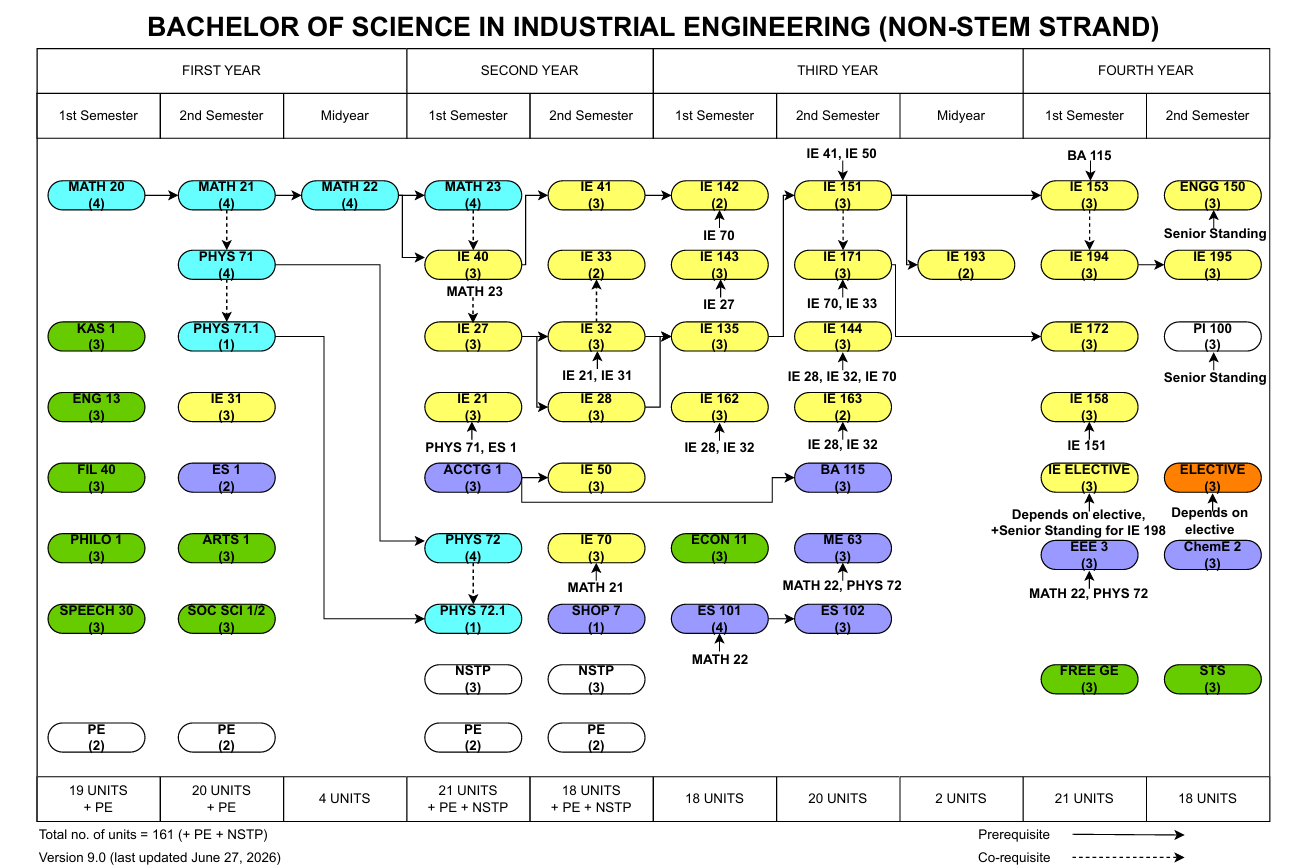
NON-STEM STRAND: 4 years, 157 units (+4 units college math)
The image below displays the undergraduate IE curriculum in flowchart form.
STEM STRAND
NON-STEM STRAND
BS Industrial Engineering Program of Study
General Education Courses, 30u total
- GE Program
- Eng 13 Writing as Thinking (3 u.)
- Fil 40 Wika, Kultura, at Lipunan (3 u.)
- Arts 1 Critical Perspective in the Arts (3 u.)
- Soc Sci 1 Foundations of Social Science / Soc Sci 2 Social, Economic and Political Thought (3 u.)
- STS 1 Science, Technology and Society (3 u.)
- Kas 1 Kasaysayan ng Pilipinas (3 u.)
- Philo 1 Philosophical Analysis (3 u.)
- Program Prescribed General Education Courses
- Econ 11 Markets and the State (3 u.)
- Speech 30 Public Speaking and Persuasion (3 u.)
- Free GE (3 u.)
Foundation Courses, 31u total (+4 units college math for NON-STEM STRAND)
- Math 20 Precalculus: Functions and their Graphs (4 u.) *NON-STEM STRAND only
- Math 21 Elementary Analysis I. Prereq: via High School Basic Calculus from the STEM or equivalent strand of K-12, Math 20 Validation Exam, or Math 20 (4 u.)
- Math 22 Elementary Analysis II. Prereq: Math 21 (4 u.)
- Math 23 Elementary Analysis III. Prereq: Math 22 (4 u.)
- Physics 71 Elementary Physics I. Coreq: Math 21 (4 u.)
- Physics 71.1 Elementary Physics I Laboratory. Coreq: Physics 71(1 u.)
- Physics 72 Elementary Physics II. Prereq. Physics 71 (4 u.)
- Physics 72.1 Elementary Physics II Laboratory. Prereq: Phys 71.1; Coreq: Phys 72 (1 u.)
- ES 1 Engineering Drawing. Prereq: None (2 u.)
- ES 101 Mechanics of Particles and Rigid Bodies. Prereq: Math 22 (4 u.)
- ES 102 Mechanics of Deformable Bodies. Prereq: ES 101 (3 u.)
Core Courses, 71u total
- IE 21 Industrial Materials and Processes (3 u.)
- IE 27 Probability and Statistics for Industrial Engineering (3 u.)
- IE 28 Statistical Analysis for Industrial Engineering (3 u.)
- IE 31 Industrial Organization and Management (3 u.)
- IE 32 Work Study and Measurement (3 u.)
- IE 33 Systems and Procedures (2 u.)
- IE 40 Mathematical Methods for Industrial Engineering (3 u.)
- IE 41 Operations Research I (3 u.)
- IE 50 Engineering Economics for Industrial Engineering (3 u.)
- IE 70 Computer Programming for Industrial Engineering (3 u.)
- IE 135 Quality Control (3 u.)
- IE 142 Operations Research II (2 u.)
- IE 143 Stochastic Processes in Engineering (3 u.)
- IE 144 Systems Simulation (3 u.)
- IE 151 Production and Service Systems (3 u.)
- IE 153 Project Development and Management (3 u.)
- IE 158 Supply Chain Management for Industrial and Service Systems (3 u.)
- IE 162 Ergonomics I (3 u.)
- IE 163 Ergonomics II (2 u.)
- IE 171 Information Systems I (3 u.)
- IE 172 Information Systems II (3 u.)
- IE 193 Industrial Engineering Practicum (2 u.)
- IE 194 Industrial Engineering Capstone Project I (3 u.)
- IE 195 Industrial Engineering Capstone Project II (3 u.)
- Engg 150 Introduction to Technology Entrepreneurship (3 u.)
Cognate Courses, 16u total
- Acctg 1 Introduction to Financial Accounting. Prereq: None (3 u.)
- BA 115 Management Accounting. Prereq: BA 99.2/Acctg. 1 (3 u.)
- ChemE 2 Elementary Chemical Engineering. Prereq: None (3 u.)
- EEE 3 Elementary Electrical Engineering. Prereq: Math 54, Physics 72. (3 u.)
- ME 63 Thermodynamics. Prereq: Math 22, Physics 72 (3 u.)
- Shop 7 General Shop Practice (1 u.)
Mandated Course, 3u total
- PI 100, The Life & Works of Jose Rizal, (3 u.)
Elective Courses, 6u total
- IE Elective, (3 u.)
- Elective, (3 u.)
Physical Education and NSTP Courses, 14u total
- PE, (2)u
- PE, (2)u
- PE, (2)u
- PE, (2)u
- NSTP, (3)u
- NSTP, (3)u
List of Approved IE Electives
- IE 122 Product Design and Development (Pre-req: IE 21. Co-req: Shop 7 ) (3 u.)
- IE 136 Manufacturing Systems (Pre-req: 4th year standing) (3 u.)
- IE 138 Manufacturing Management (Pre-req: 4th yr. standing ) (3 u.)
- IE 139 Reliability Engineering for Industrial Systems (Pre-req: IE 135; IE 143) (3 u.)
- IE 152 Manufacturing Planning and Design (Pre-req: IE 151. Co-req: IE 144) (3 u.)
- IE 161 Safety and Health Management (Pre-req: IE 160 or COI) (3 u.)
- IE 173 Data Analytics for Industrial Engineering (IE 171or equiv, IE 27or equiv) (3 u.)
- IE 174 Software Tools for Industrial Engineering (Pre-req: ES 26 or COI) (3 u.)
- IE 197 Special Topics (Pre-req: None) (3 u.)
- IE 198 Special Problems (Pre-req: Senior Standing) (3 u.)
List of Approved Non-IE Electives
- BA 151 Human Behavior in Organizations (Pre-req: BA 101 or COI) (3 u.)
- BA 152 Human Resource Management (Pre-req: BA 151 or COI) (3 u.)
- BA 170 Introduction to Marketing Management (Pre-req: BA 101) (3 u.)
- Econ 100.1 Introduction to Macroeconomic Theory and Policy (Pre-req: Math 11 or COI) (3 u.)
- Econ 100.2 Introduction to Microeconomic Theory and Policy (Pre-req: Math 11 or COI) (3 u.)
- EgyE 101 Introduction to Energy Engineering (Pre-req: Senior Standing) (3 u.)
- EnE 31 Technology and Environment (Pre-req: Prereq: 3rd yr. standing) (3 u.)
- MetE 143 Elements of Materials Science (Pre-req: Chem 16, Physics 72) (3 u.)
- Psych 101 General Psychology (3 u.)
*Other courses acceptable to the degree program sponsor
Course Descriptions
Foundation Courses
Math 20 Precalculus: Functions and their Graphs. Equations and inequalities; two dimensional coordinate system, graphs of equations; conic sections; functions and their graphs; trigonometric functions and trigonometric identities; inverse trigonometric functions; solutions of triangles; polar form of complex numbers. Pre–requisites: High School Algebra/Equivalent. Credit: 4 units (4 hrs lecture).
Math 21 Elementary Analysis I. Limits and continuity; derivatives of algebraic and transcendental functions (exponential, logarithmic, trigonometric, hyperbolic, and their inverses); applications of derivatives; antiderivatives and definite integrals; Fundamental Theorem of Calculus; applications of the definite integral. Pre–requisites: High School Basic Calculus/Math 20/Equivalent. Credit: 4 units (4 hrs lecture).
Math 22 Elementary Analysis II. Techniques of integration; improper integrals; parametric equations and polar coordinates; lines in space, planes, cylindrical surfaces, surfaces of revolution, and quadric surfaces; vectors and vector-valued functions; sequences and series. Pre–requisites: Math 21/Equivalent. Credit: 4 units (4 hrs lecture).
Math 23 Elementary Analysis III. Functions of several variables; limits and continuity of functions of several variables; partial derivatives and the total differential; directional derivatives; relative and absolute extrema of functions of several variables; double and triple integrals; applications of multiple integrals; vector fields; line and surface integrals. Pre–requisites: Math 22/Equivalent. Credit: 4 units (4 hrs lecture).
Physics 71 Elementary Physics I. Mechanics of particles, rigid bodies and fluids. Pre–requisites: None. Co–requisite: Math 21/Equivalent. Credit: 4 units (3 hrs lecture, 1 hr discussion).
Physics 71.1 Elementary Physics I Laboratory. Pre–requisites: None. Co–requisite: Physics 71. Credit: 1 unit (2 hrs laboratory).
Physics 72 Elementary Physics II. Electricity and magnetism, wave phenomena, and optics. Pre–requisites: Physics 71. Co–requisite: None. Credit: 4 units (3 hrs lecture, 1 hr discussion).
Physics 72.1 Elementary Physics II Laboratory. Pre–requisites: Physics 71.1. Co–requisite: Physics 72. Credit: 1 unit (2 hrs laboratory).
Core Courses
IE 21 Industrial Materials and Processes. Industrial materials and processes and their effects on production system decisions. Pre–requisites: Physics 71, ES 1. Co–requisite: None. Credit: 3 units (3 hrs lecture).
IE 27 Probability and Statistics for Industrial Engineering. Applications of logic and probability in industrial engineering; random variables and their functions, descriptive statistics, discrete and continuous probability distributions and their applications. Sampling theory. Estimation and tests of hypotheses. Pre–requisites: None. Co–requisite: Math 23/Equivalent. Credit: 3 units (3 hrs lecture).
IE 28 Statistical Analysis for Industrial Engineering. Regression, correlation, analysis of variance, design of experiments and their applications in industrial engineering. Pre–requisite: IE 27. Co–requisite: None. Credit: 3 units (3 hrs lecture).
IE 31 Industrial Organization and Management. Basic features governing the organization, administration, and financing of industries. Relations between labor and management. Pre–requisite: None. Co–requisite: None. Credit: 3 units (3 hrs lecture).
IE 32 Work Study and Measurement. Productivity concepts and techniques; method study and work measurement; wage payment; indirect and expense labor standards; training practices. Pre–requisites: IE 21, IE 27, IE 31. Co–requisite: None. Credit: 3 units (2 hrs lecture, 3 hrs laboratory).
IE 33 Systems & Procedures. Systems documentation and charting; introduction to information management and related ISO standards; systems and procedures best practices. Pre–requisite: None. Co–requisite: IE 32. Credit: 2 units (2 hrs lecture).
IE 40 Mathematical Methods for Industrial Engineering. Theory and applications of linear algebra, differential equations, and numerical methods for Industrial Engineering. Pre–requisite: Math 22/Equivalent. Co–requisite: Math 23/Equivalent. Credit: 3 units (3 hrs lecture).
IE 41 Operations Research I. Operations research methodology; optimization models for linear systems; linear programming; duality and sensitivity analysis; transportation, assignment, and network models. Pre–requisite: IE 40. Co–requisite: None. Credit: 3 units (3 hrs lecture).
IE 50 Engineering Economics for Industrial Engineering. Concepts and tools of economic analysis for decision-making. Interest and money-time relationships. Single and multiple project evaluation. After-tax economy studies. Decisions recognizing risk and uncertainty. Pre–requisite: Acctg 1/Equivalent. Co–requisite: None. Credit: 3 units (3 hrs lecture).
IE 70 Computer Programming for Industrial Engineering. Design and analysis of computational algorithms for Industrial Engineering problems. Pre–requisite: Math 21/Equivalent. Co–requisite: None. Credit: 3 units (2 hrs lecture, 3 hrs laboratory).
IE 135 Quality Control. Concept of quality, costs of quality, introduction to quality management systems. Pre–requisite: IE 28, IE 32. Co–requisite: None. Credit: 3 units (2 hrs lecture, 3 hrs laboratory).
IE 142 Operations Research II. Integer programming; dynamic programming; goal programming; game theory. Pre–requisites: IE 70/Equivalent, IE 41. Co–requisite: None. Credit: 2 units (2 hrs lecture).
IE 143 Stochastic Processes in Engineering. Elements of stochastic processes; queuing theory and decision models; Markov chains, renewal theory and its applications to engineering problems. Pre–requisite: IE 27. Co–requisite: None. Credit: 3 units (3 hrs lecture).
IE 144 Systems Simulation. Simulation of complex discrete event systems with applications in manufacturing and service organizations; random number and variate generation, input distribution modeling, statistical analysis of simulation output; case studies. Pre–requisites: IE 70/Equivalent, IE 28, IE 32. Co–requisite: None. Credit: 3 units (2 hrs lecture, 3 hrs laboratory).
IE 151 Production and Service Systems. Capacity planning. Forecasting. Production planning. Scheduling and inventory control. Maintenance. Production Control. Production information system. Pre–requisites: IE 41, IE 50, IE 135. Co–requisite: None. Credit: 3 units (2 hrs lecture, 3 hrs laboratory).
IE 153 Project Development and Management. Phases of project feasibility studies. Project development, evaluation and management. Pre–requisites: BA 115/Equivalent, IE 151. Co–requisite: None. Credit: 3 units (2 hrs lecture, 3 hrs laboratory).
IE 158 Supply Chain Management for Industrial and Service Systems. An overview of concepts, processes, and best practices that are used in the management of supply chains. Supply chain management, procurement, customer relationship management, finance, information technologies, logistics activities and case studies. Pre–requisite: IE 151. Co–requisite: None. Credit: 3 units (3 hrs lecture).
IE 162 Ergonomics I. Origins and development of human factors and ergonomics. Physical ergonomics and the tools and techniques of physical ergonomic risk assessment, ergonomic workplace design and evaluation. Human factors research methods. Pre–requisites: IE 32, IE 28. Co–requisite: None. Credit: 3 units (2 hrs lecture, 3 hrs laboratory).
IE 163 Ergonomics II. Introduction to cognitive ergonomics and relation of cognitive limitations to design of effective displays and controls. Human-computer interaction. Pre–requisite: IE 32, IE 28. Co–requisite: None. Credit: 2 units (1 hr lecture, 3 hrs laboratory).
IE 171 Information Systems I. Concepts and frameworks of information systems. Analysis and design of information systems. Pre–requisites: IE 70/Equivalent, IE 33. Co–requisite: IE 151. Credit: 3 units (3 hrs lecture).
IE 172 Information Systems II. Implementation considerations in information systems design. Relational database systems. Pre–requisite: IE 171. Co–requisite: None. Credit: 3 units (3 hrs lecture).
IE 193 Industrial Engineering Practicum. On-the-job training or industry internship. Pre–requisite: IE 151. Co–requisite: None. Credit: 2 units (100 hrs field).
IE 194 Industrial Engineering Capstone Project I. Systems engineering design project proposal development. Problem identification and formulation. Pre–requisite: None. Co–requisites: IE 153. Credit: 3 units (2 hrs lecture, 3 hrs laboratory).
IE 195 Industrial Engineering Capstone Project II. IE undergraduate capstone project second course. Team-based systems engineering design project. Design solutions from a systems perspective. Pre–requisite: IE 194. Co–requisite: None. Credit: 3 units (1 hr lecture, 6 hrs laboratory).
Engg 150 Introduction to Technology Entrepreneurship. Fundamentals of technology entrepreneurship, intellectual property, industry creation, and technology strategy. Opportunity recognition and evaluation. Business model development. Management of ventures. Pre–requisite: Senior Standing. Co–requisite: None. Credit: 3 units (3 hrs lecture).
Approved IE Electives
IE 122 Product Design & Development. Framework for product life cycle design, integrated product & process design, development, prototyping & evaluation. Pre–requisite: IE 21. Co–requisite: Shop 7. Credit: 3 units (2 hrs lecture, 3 hrs laboratory).
IE 136 Manufacturing Systems. Primary activities of a manufacturing firm. Manufacturing practices. Pre–requisite: Fourth Year Standing. Co–requisite: None. Credit: 3 units (3 hrs lecture).
IE 138 Manufacturing Management. Organizational & financial aspects of manufacturing. Manufacturing management principles. Pre–requisite: Fourth Year Standing. Co–requisite: None. Credit: 3 units (3 hrs lecture).
IE 139 Reliability Engineering for Industrial Systems. Basic concepts of reliability engineering. Reliability measurement system. Reliability analysis methods. Failure mode and effects analysis. Fault tree analysis. Risk analysis. Human reliability. Life testing, Reliability testing and evaluation. Design for reliability applications. Pre–requisites: IE 135, IE 143. Co–requisite: None. Credit: 3 units (3 hrs lecture).
IE 152 Manufacturing Planning and Design. Manufacturing process design. Location & layout of facilities. Materials flow systems. Materials handling. Storage & distribution. Pre–requisite: IE 151. Co–requisite: IE 144. Credit: 3 units (3 hrs lecture).
IE 161 Safety & Health Management. Hazard analysis techniques, human error analysis, safety standards & hazard communication; application of human factors & engineering practice in accident prevention & the reduction of health hazards on living & work environment. Pre–requisite: IE 160 or COI. Co–requisite: None. Credit: 3 units (3 hrs lecture).
IE 173 Data Analytics for Industrial Engineering. Overview of data analytics and data mining. Design of end-to-end data mining processes, current methodologies and best practices used to transform raw data into useful information to support decision making. Pre–requisites: IE 171 Information Systems I or equivalent, and IE 27 or equivalent. Co–requisite: None. Credit: 3 units (2 hrs lecture, 3 hrs laboratory).
IE 174 Software Tools for Industrial Engineering. Introduction to computer software packages for Industrial Engineering applications. Pre–requisite: ES 26, COI. Co–requisite: None. Credit: 3 units (2 hrs lecture, 3 hrs laboratory).
IE 197 Special Topics. Credit: 3 units (3 hrs lecture).
IE 198 Special Problems. Pre–requisite: Senior standing. Credit: 3 units (3 hrs lecture).
Cognate Courses
ES 1 Engineering Drawing. Technical sketching, lettering, instrumental drawing. Multiview projections. Pictorial drawing. Conventions and dimensioning. Graphs and charts. Pre–requisites: None. Co–requisite: None. Credit: 2 units (6 hrs laboratory).
ES 101 Mechanics of Particles and Rigid Bodies. Force, moment, and motion concepts. Newton’s Laws of Motion. Analysis of particles and rigid bodies in static and dynamic equilibrium using vector mechanics, momentum methods, and energy methods. Geometric properties to lines, areas, and volumes. Pre–requisites: Math 22/Equivalent. Co–requisite: None. Credit: 4 units (3 hrs lecture, 3 hrs laboratory).
ES 102 Mechanics of Deformable Bodies. Internal forces and moments in members subjected to different loadings. Material properties. Deformation, strain and stress analysis and design of members subjected to axial, torsional, shear, and flexural loads. Stress transformations using equilibrium and Mohr’s circle. Theories of material failure. Pre–requisites: ES 101. Co–requisite: None. Credit: 3 units (3 hrs lecture).
ChemE 2 Elementary Chemical Engineering. Introduction to chemical engineering calculations; elementary mass and energy balances for common unit operations and unit processes. Pre–requisites: None. Co–requisite: None. Credit: 3 units (3 hrs lecture).
EEE 3 Elementary Electrical Engineering. Fundamentals of electric and magnetic circuits; transformers; direct and alternating current machinery; elementary distribution systems and electrical wiring. Pre–requisites: Math 22/Equivalent, and Physics 72. Co–requisite: None. Credit: 3 units (3 hrs lecture).
ME 63 Thermodynamics. First and second laws of thermodynamics. Properties of thermodynamic media. Ideal gases. Thermodynamic cycles. Pre–requisites: Math 22/Equivalent, and Physics 72. Co–requisite: None. Credit: 3 units (2 hrs lecture, 3 hrs laboratory).
Acctg 1 Introduction to Financial Accounting. Accounting concepts and principles applied to service, merchandising, and manufacturing operations; partnerships and corporations; the analysis, interpretation, and uses of accounting data for management. Pre–requisites: None. Co–requisite: None. Credit: 3 units (3 hrs lecture).
BA 115 Management Accounting. Uses of accounting information for managerial planning and control. Pre–requisites: Acctg 1/Equivalent. Co–requisite: None. Credit: 3 units (3 hrs lecture).
Shop 7 General Shop Practice. The use of equipment for machining, welding, casting, and allied practices. Pre–requisites: None. Co–requisite: None. Credit: 1 unit (3 hrs laboratory).